System Architecture
ForesightX uses focused microservices so that identity, market data, prediction, user context, and recommendation logic can evolve independently. The frontend and NGINX provide a unified product surface while the backend retains explicit ownership boundaries.
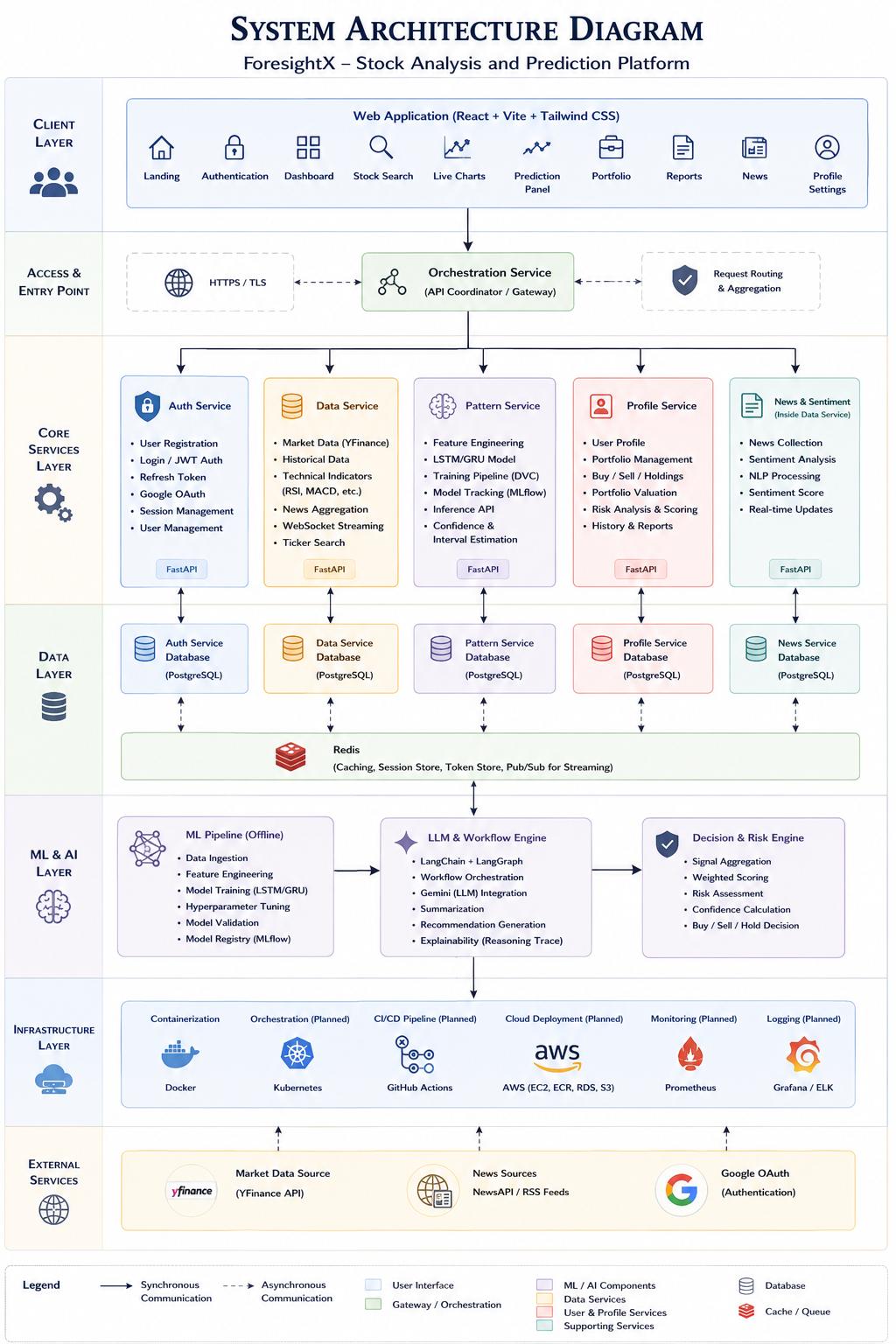
Runtime topology
Internet
  |
  v
NGINX reverse proxy
  |-- /                 -> React frontend
  |-- /api/auth/        -> Auth service
  |-- /api/profile/     -> Profile service
  |-- /api/data/        -> Data service
  |-- /api/pattern/     -> Pattern service
  `-- /api/orchestration -> Orchestration service
Backend containers do not need public host ports. They resolve one another by Docker service name and expose health endpoints for startup and operational checks.
Service ownership
| Service | Owns | Primary dependencies |
|---|---|---|
| Frontend | User experience and client session state | NGINX API routes |
| Auth | Credentials, OAuth linkage, access and refresh tokens | PostgreSQL, Redis, Profile service |
| Data | Instruments, prices, indicators, news, streaming | Market providers, PostgreSQL, Redis |
| Pattern | Feature transformation and model inference | Model artifacts, MLflow/DVC metadata |
| Profile | User details, cash, positions, transactions, risk | PostgreSQL, Data service |
| Orchestration | Analysis jobs, workflow events, final recommendation | Data, Pattern, Profile, Gemini |
Analysis request flow
- The client sends
POST /analyzeto the orchestration route. - Orchestration validates the request and creates workflow state.
- Market data, prediction, and user context are collected through service tools.
- Signals are normalized and combined into an analysis view.
- Gemini can produce a structured explanation; deterministic logic remains available as a fallback.
- Risk checks constrain the result using exposure and volatility context.
- The response returns the action, confidence, evidence, and trace while analysis events are persisted.
Component view
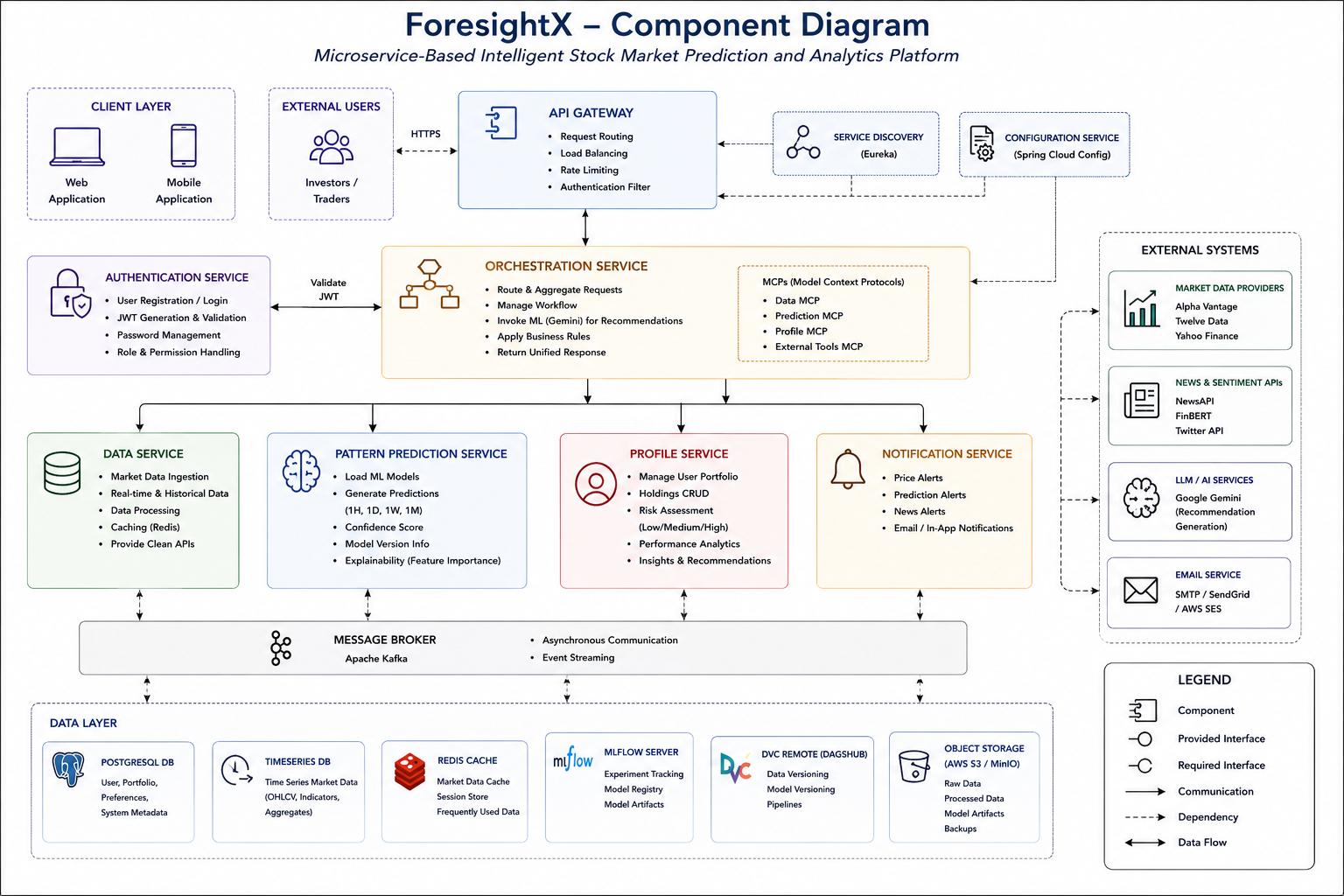
The component model shows a deliberate separation between presentation, API services, persistence, external providers, MLOps, and deployment infrastructure. This keeps external integrations at service boundaries instead of leaking them into the frontend.
Reliability strategy
- Redis caches market data and supports revocable session state.
- Services validate external responses before exposing normalized contracts.
- Health checks distinguish a running process from a functioning service.
- Orchestration can degrade to deterministic recommendation logic when AI assistance is unavailable.
- Each service can be restarted or scaled without rebuilding the whole application.
Data flow
The data service normalizes price, history, indicator, and news information. The pattern service consumes a defined historical feature window rather than reaching directly into another service's database. The profile service supplies only the portfolio and risk context required for analysis. Orchestration combines these API-level outputs and owns the resulting job trace.
This contract-first flow avoids cross-service database access and preserves independent migrations.