Development Process
ForesightX followed an Agile incremental model. The project contained several independent but connected areas: ML experimentation, backend services, frontend design, orchestration, deployment, and documentation. Building in increments allowed each area to be tested before the next integration step.
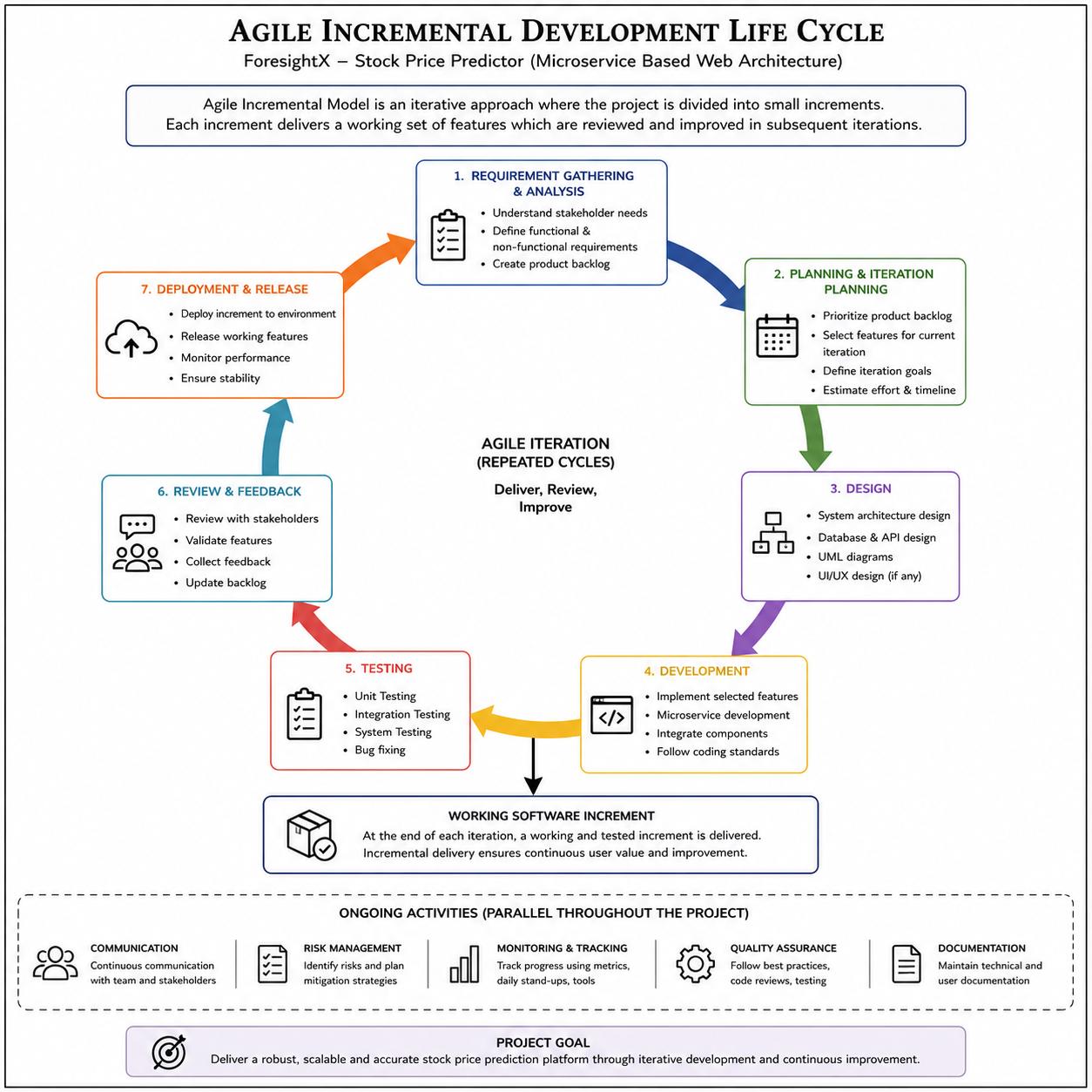
Development cycle
- Define the next requirement and service contract.
- Design the smallest useful increment.
- Implement it inside the owning service.
- Test the service in isolation.
- Integrate it with its consumers.
- Review behavior and adjust the next increment.
Repeated integration checks were important because a response-shape change in one service could otherwise break the frontend or orchestration workflow much later.
Phase-wise development
- Requirement analysis: user role, platform scope, service boundaries, and expected outputs
- Model planning: features, horizons, artifact strategy, and inference response contract
- Service implementation: Pattern, Data, Auth, Profile, and Orchestration APIs
- Frontend implementation: responsive pages and API integration
- System integration: end-to-end analysis and portfolio paths
- Deployment: Docker images, Compose networking, NGINX, and health checks
- Validation: unit tests, API checks, database inspection, and report preparation
Team structure
The project report records a two-member team:
| Member | Primary responsibility |
|---|---|
| Aditya Pratap Singh Tomar | Architecture, backend APIs, ML workflow, orchestration, and deployment organization |
| Stuti Jain | Frontend design, interface implementation, integration checks, and documentation support |
The team used an architecture-first collaboration pattern: agree on the next contract, implement in parallel where possible, review the integrated result, and then continue to the next increment.