Execution Plan
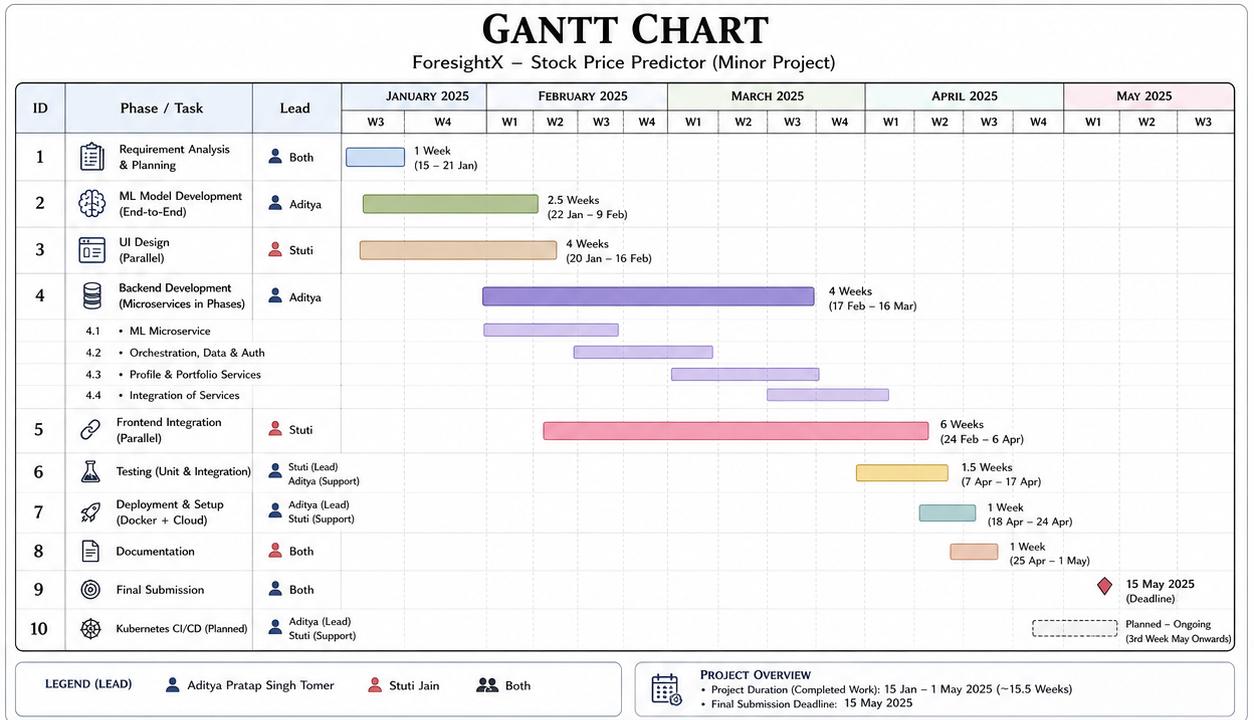
The reported project schedule ran from mid-January 2025 through the end of April 2025. Sequential work was used where one output depended on another; UI, backend, and documentation tasks were parallelized where practical.
Milestones
| Milestone | Status | Outcome |
|---|---|---|
| Problem and scope definition | Completed | Defined a bounded decision-support product |
| ML pipeline architecture | Completed | Established feature, training, and inference flow |
| Service implementation | Completed | Delivered Auth, Data, Pattern, Profile, and Orchestration services |
| Frontend integration | Completed | Connected the user interface to backend workflows |
| Docker deployment | Completed | Produced repeatable local and EC2-oriented execution |
| Testing and documentation | Completed | Verified behavior and captured system design |
| Kubernetes and expanded CI/CD | Planned | Reserved as a later scaling stage |
Week-wise progression
| Weeks | Focus | Result |
|---|---|---|
| 1 | Planning and scope | Project direction finalized |
| 2-4 | ML architecture | Prediction approach established |
| 3-6 | Frontend/UI | Interface foundation prepared |
| 5-8 | Core microservices | Auth, Data, and Pattern APIs completed |
| 7-9 | Orchestration | Integrated analysis flow formed |
| 8-10 | Profile | Portfolio and risk context added |
| 10-11 | Integration | End-to-end paths verified |
| 11-12 | Deployment | Containerized execution achieved |
| 12-13 | Documentation | Report, screenshots, and cleanup completed |
Gantt chart
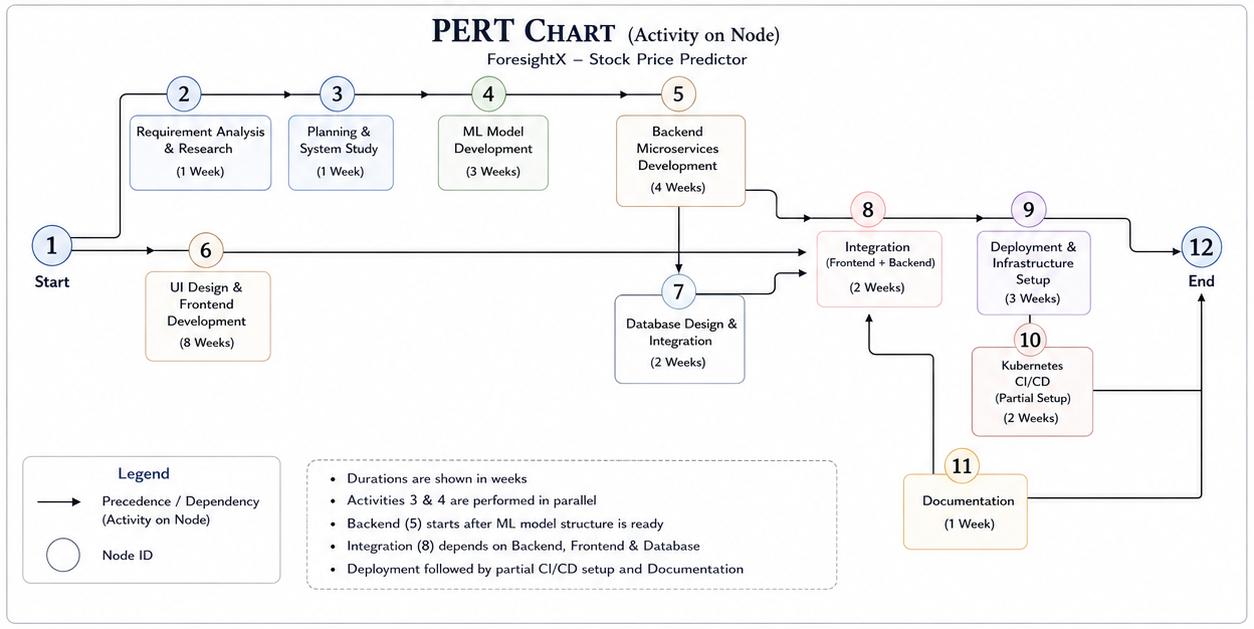
PERT chart
Risks and mitigation
The primary technical risk was contract drift between independently developed services. Incremental integration and service-level tests reduced the chance of discovering incompatible response formats at the end of the project.
The primary delivery risk was time pressure near submission. Parallel frontend, backend, and documentation work preserved time for final integration and validation.